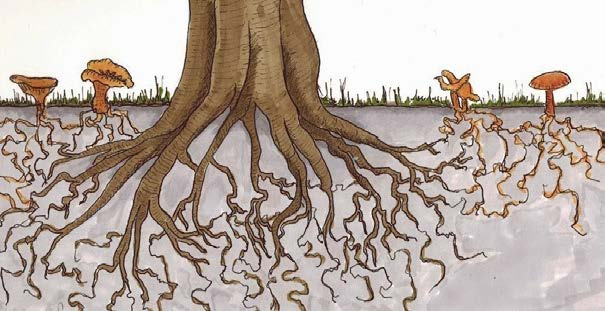
(Illustration courtesy Kauai Seascape Nursery)
Before taking a deep dive underground, I must pay tribute to leaves for their remarkable abilities. If a predator begins munching on the leaves of one tree, that tree sends a chemical signal to nearby trees warning them to mount their defenses. The neighboring trees respond by sending substances into their leaves which makes them unpalatable. And it is in the leaves where photosynthesis takes place by combining water, sunlight and absorbed carbon dioxide to produce sugar, the staple food for the tree and nutritional support for nearby trees in need through the mycelium network under the ground.
The Underground Network

scattered spores keep the mycelium growing
(Illustration courtesy Kauai Seascape Nursery)
Mycelium are threadlike strands of fungi that attach themselves to tree roots of different species, creating what one researcher calls “nature’s world-wide web.” Trees have a way of communicating with one another. They can send nutrients like nitrogen and phosphorus to an ailing neighbor, making up part of the vast system that supplies water and nutrients to undernourished trees nearby. And the underground network also sends warning messages and alerts about impending conditions like drought.
Understanding the language of trees is an ever-expanding field of research, and for the student like myself, this knowledge deepens my awareness of trees. No longer can I consider trees non-sentient beings as I once believed. Their own particular form of “intelligence” may help trees survive in a changing world.
 Phila Rogers