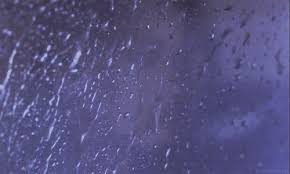
 Take this week – in the middle of October. All day the clouds continued to build up against the mountains. And at bedtime, I heard an unfamiliar sound. Opening the door, I was surprised by rain. Pulling open the window next to my bed, I fell asleep to the comforting sound of rain falling, while breathing in that indescribable fragrance of earth refreshed. The morning that followed was the freshest we’ve had in this endless season of harsh drought.
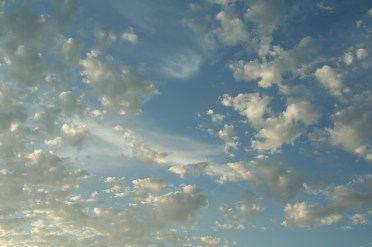 By Wednesday, the temperature rose to 95 degrees, the humidity descended into the single digits, the red fire danger flags were posted. By the weekend the scene changed again. I could joyfully proclaim fall as it should be – a sky full of clouds of every shape in shades of gray and white. I’ve cracked open the door so I can feel the cool breeze and hear the birds as I work on my computer.
Nothing energizes the bird population like a change in the weather, especially when there is the possibility of rain. If you trust forecasts, rain may be moving our way, coming from the north, the most reliable direction.
Being an incurable nostalgic I remember days like this in the Bay Area we called the “second spring.” The first rain of the fall brought up sprouts of green grass on the hills, certain native plants set buds or even bloomed, and the birds began singing again. I guessed that maybe they were fooled by day and night equaling in length, the way it did during the spring equinox.
More knowledgeable birdwatchers than me, call this “second spring” “Autumnal Recrudescence,” a word new to me. Looking the word up, I read that it was most often a medical term meaning the return of an illness after a remission. Or it could mean the recurrence of an unpleasant feeling like doubt.
Naturalist give the word a happier meaning.
The Autumnal Recrudescence of the Amatory Urge
When the birds are cacophonic in the trees and on the verge
Of the fields in mid-October when the cold is like a scourge.
It is not delight in winter that makes feathered voices surge,
But autumnal recrudescence of the amatory urge.
When the frost is on the pumpkin and when leaf and branch diverge,
Birds with hormones reawakened sing a paean, not a dirge.
What’s the reason for their warbling? Why on earth this late-year splurge?
The autumnal recrudescence of the amatory urge.

-Written by Susan Stiles, copyright December 1973
After the mostly silent late summer, I was delighted with the bird chorus. I also attributed it to the completion of energy-robbing activities like nesting followed by molting where in most species, every feather had to be replaced with a new one.
The arrival of the winter residents certainly energized the local, year-round population. The regulars and newcomers set about declaring and defending their winter territories.

Wanting to better understand fall in Santa Barbara sent me back to Joan Lentz’s “A Naturalist’s Guide to the Santa Barbara Region,” my bible on all things local. She says that the distinction between summer and fall is more pronounced than between spring and summer. Enter our old friend or nemesis The North Pacific High. If the atmosphere behaves as it should, this zone of high pressure which held sway over the summer, producing the northwest winds blowing down the coast and causing coastal fog, should begin to move south following the sun. Winds cease and with them the fog. A rain may even sneak through as it had last Sunday evening. With less fog, the skies are clearer and the blue skies are a palette for the extraordinary clouds of fall.
In the Berkeley Hills where I’ve lived most of my life, we especially dreaded the August fogs with their frigid winds when the gloomy, damp overcast could persist for days on end. When late September brought relief, we were ecstatic. Both in the Bay Area and in Santa Barbara, fall winds sometimes blew from the north and northeast, coming from the Great Basin, bringing the odors of sage and when passing over the mountains, the tangy smell of conifers.
Though Santa Barbara, by its location and topography, is spared the full impact of the Santa Anas (unlike the LA basin), we often have the offshore winds, heat, and lower humidity.
In my drives around town I look for autumn color to further affirm the change of season. Sycamores, which grow wherever there is a little ground moisture, have been dropping leaves all summer and even in the best of years are only a dusky gold, showing their best color when back lit by the sun. Liquidambars, also called sweet gum, a native to the southeast, are beginning to show their autumn color, but we will have to wait until late November for their best display.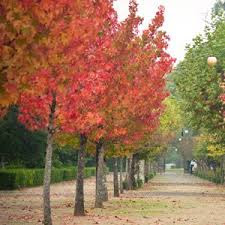
Weary of my endless comparisons between Berkeley and Santa Barbara, my daughter decided it was time for a drive over the mountain to the Santa Ynez Valley, for a change of scene. And change of scene, indeed! What a difference a mountain range makes. The Santa Ynez Valley is hotter in the summer and colder in the winter. The continental influences prevail, moderated somewhat by the proximity to the coast and the ocean. But the sub-tropical trees in Santa Barbara’s parks and gardens would not succeed here.

This is the wide-open country of vineyards and olive orchards where the horse is king. Some ranches provide individual horse casitas with white stucco walls, tiled roofs, and individual corrals.
And, yes, I did find the color I was hoping for in the bright yellow cottonwoods growing along the dry Santa Ynez River watercourse. We like to be drenched in the fall brilliance of yellows, oranges, and red – this intoxicating dazzle – the final flaring before the bare trees in the dimming light and short days of winter.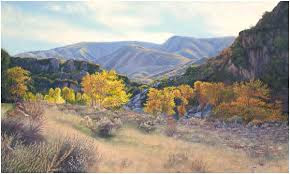
But what pleased me the most were the ambers of the vineyards, the pale grasses long spent and all the other shades of gray-greens, ochers, umbers and shades of color for which I have no names — and the swirls and small bunches of white clouds against a soft blue sky.
Once I yearned to live in open country with only distant neighbors if any at all, under a curving sky with stars beyond counting, winds that travelled long distances unobstructed, and the distant yips and howls of coyotes.
But I was content enough to return back over the mountain, to the marine air which is kinder, and to a town of neighborhoods where lights in other windows comfort me. On the weekends, music and voices of children come up the hill from the city park below. Once the winter rains begin, I will hear the music of Mission Creek.
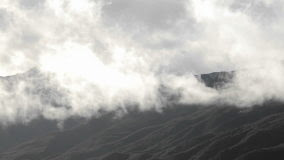 Yesterday, at the end of the month, the clouds thickened during the day. In the afternoon, a few large drops fell. The air felt dense and heavy, maybe rich in negative ions which some say lifts the spirits.
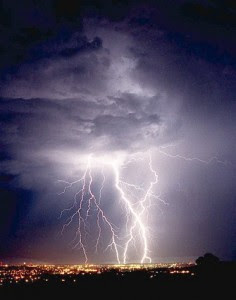 Around 3 am, we awoke to a long roll of thunder. For the next hour, lightning and thunder alternated, until the lightning seemed to rip open the heavy undersides of the clouds releasing a torrent which in a few minutes left behind a half inch of rain. At the end of the day, the clouds had retreated back to the mountains.
It appears that at last I have the intemperate Santa Barbara I had expected – a Santa Barbara of sundowner winds gusting down canyons, landslides, firestorms and debris flows, floods, thunder ricocheting off the
mountain sides, and on the coast, high surfs which rearrange beaches.
Is this the fall and winter which will end the drought? Such secrets are closely held. In the meantime, I look often at the sky, sniff the air, and even conger up promising clouds. It can’t hurt.
Some of the birds which arrive in the Fall


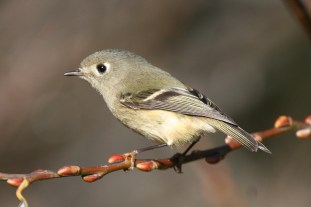
Photos by Tom Ginn

 canyon, but it’s when the sun is low in the sky before sunset that the mountains reveal their contours. Purple shadows fill the canyons while ridges and peaks glow in the late light. I learned by studying a map that the deep shadow in the saddle west of Montecito Peak is the top of Cold Spring Canyon.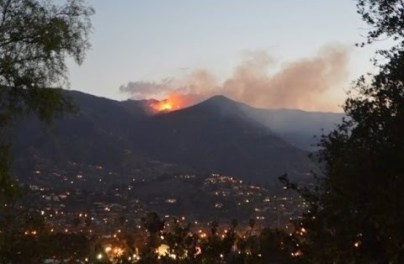
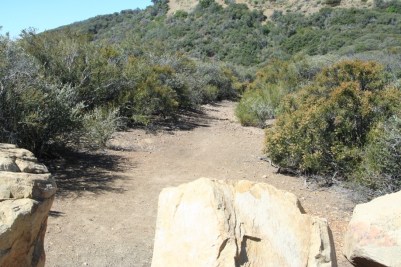
 and three large boulders across the dirt road. The trail – the dirt road – continues just beyond the level section when it becomes a narrow trail dropping steeply down to where Mission Creek begins. The Falls are a popular destination for hikers, most hiking up from Tunnel Trail off Tunnel Road. I’ve never hiked up far enough to reach the falls so I have to rely on the reports of others and the photos they took.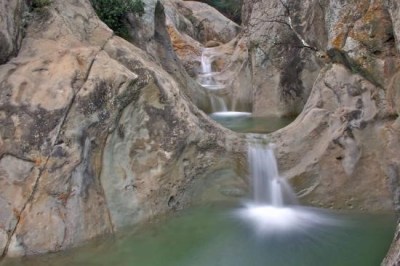



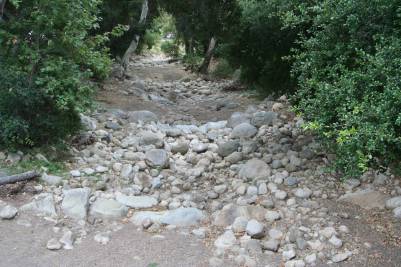
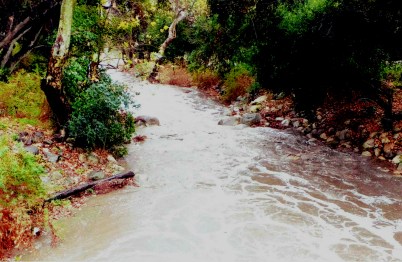 arden, is often reduced to a few algae-filled pools.


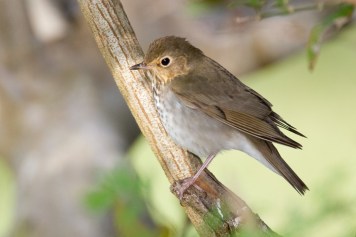
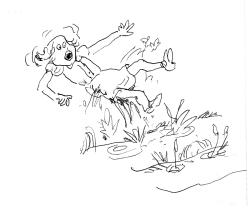 The slope was too steep to navigate on foot so I slid on my behind through what I would later discover was mostly poison oak. After an almost vertical slope of slippery clay, I found myself at the edge of a creek. And there was my bird, silent now, who fixed me with it’s round eye, made even rounder by a circle of white feathers. Late in the spring, the creek was reduced to a series of dark pools, laced together by threads of running water. Water striders skated across the surface while dragonflies darted about occasionally touching the water.

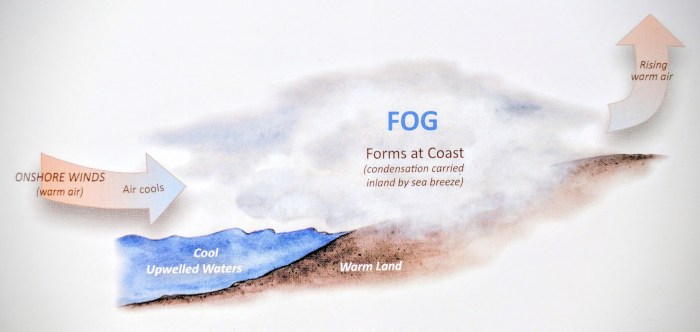


 decreasing coastal fogs when the Pacific High begins to slowly shift south allowing for the possibility of an early rain coming down from the north. Or when humidity sometimes moves north bringing the possibility of a thunderstorm and wonderful cloud effects. Exotic weather heightens one’s senses.
 I’m also reading about how coastal fogs along the north coast have allowed the redwood forest to persist. Once, when the climate was much wetter, redwoods were common over much of the continent. But as the climate became drier and cooler, the redwood forests retreated to a narrow band along the immediate coast of Northern California visited by ocean fogs in the summer.
 ering the Great Central Valley can blot out the sun for days on end until the next rain storm sweeps the fog away for a time. The so-called radiation fog often follows the rain when the earth is both chilled and damp and the drier air above it condenses, forming fog. I remember once driving across the Sacramento Valley at night and I could see that the fog came up to the cow’s belly, leaving its head in the clear.
 up to a hundred gallons a day.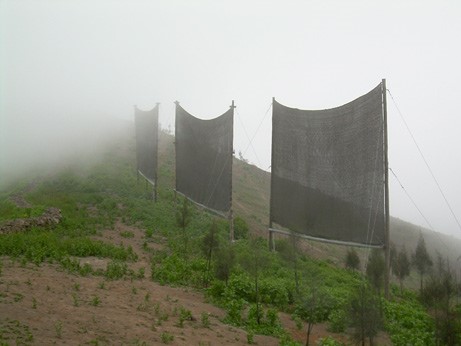
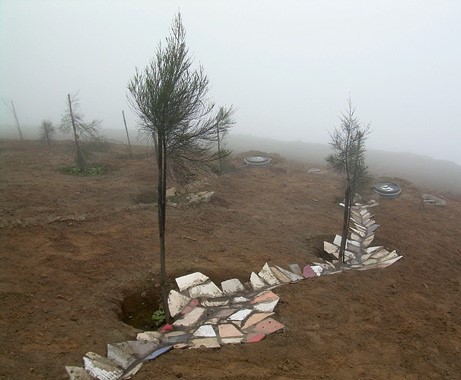 The newly-planted 700 tara trees will be able to eventually collect their own water. Tara trees produce valuable tannin.
 Phila Rogers