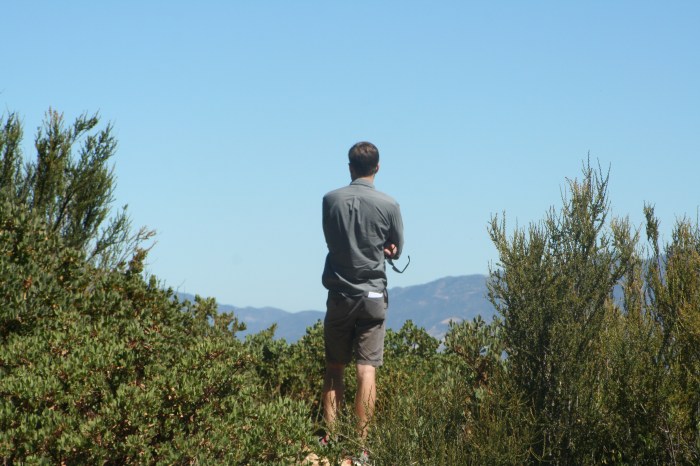
Sitting on a bench at Franceschi Park in the foothills above Santa Barbara, I look over the city. The streets are laid out in grids, dense with houses and buildings. The beach is backed by rows of tall palms. The harbor is filled with boats of every description. I can’t help but think about how the same scene would have looked a thousand years ago.
Wiping the palette clean, what I now see is a narrow plateau sloping gradually to the sea. The conical, thatched huts of a Chumash village cluster where a stream enters the ocean. Offshore are several plank canoes with paddlers headed across the Channel to smaller villages on the Santa Cruz and Santa Rosa Islands.
This scene persists until the arrival of Europeans in the late 1700s, when the Spanish coming up from Mexico established a string of missions along the coast. At the larger missions, such as the one at Santa Barbara, a small village grows up around its presidio.
It was to this Santa Barbara on a warm and windless January day in 1834, that The Pilgrim, a brig out of Boston, dropped anchor offshore. Aboard was a young student from Harvard, Richard Henry Dana. He would later write the story of his adventures on the high seas and along the coast of California for a year of gathering hides and tallow. His story would become one of the best-loved books of American literature: “Two Years Before the Mast.”
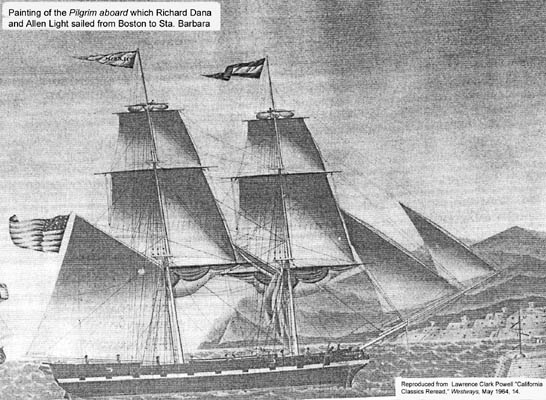
What Dana saw at Santa Barbara was a small village of about 100 white-washed adobes with red-tiled roofs, surrounding the larger presidio. The mission built on a slope above the town served as the mark where the vessels came to anchor.
The town is finely situated with a bay in front, and an amphitheater of hills behind. The only thing which diminishes its beauty is that the hills have no trees upon them, they having been all burnt by a great fire which swept them off about a dozen years ago, and they have not yet grown again. The fire described to me by an inhabitant, as having been a terrible and magnificent sight. The air of the valley was so heated that the people were obliged to leave the town and take up their quarters for several days upon the beach (January 1835).

As a lad from Massachusetts, he would have expected the hills and mountains to be covered with trees. He must have been puzzled by this dry, central California landscape where steep sandstone mountains could only support gray-green chaparral.
Sailing ships coming to Santa Barbara typically anchored three miles offshore, as this was an exposed and dangerous roadstead.
The whole swell of the Pacific Ocean rolls in here before a southeaster, and breaks with so heavy a surf in the shallow water, that it is highly dangerous to lie near in to the shore during the southeaster season, that is, between the months of November and April. The wind is the bane of the coast of California (January 1835)
Along the length of the California coast only San Diego and Monterey offered a reasonably safe anchorage, with San Francisco Bay offering the most secure. Dana extols San Francisco Bay, prophesizing that San Francisco will someday be one of the great cities.
The crew of The Pilgrim spent almost a year on the California coast gathering and preparing hides for transport back to Boston, where factories produced finished leather goods. Hide and tallow were the principle exports at a time when the land was divided into vast ranchos where herds of long-horned cattle roamed freely.
On one trip up the coast to Point Conception, the ship encountered a ferocious gale that blew unabated for three nights and days. Even some of their reefed sails were ripped, and they were blown far out to sea. Point Conception and Point Arguello, located where the coast bends inward, are still notorious for brutal winds in all seasons.
The Pilgrim made several stops at Santa Barbara over the year. One visit was when the youngest daughter of the De La Guerra family married the American agent, Alfred Robinson. It was a grand ceremony beginning at the Mission and continuing with a “fandango,” at the De La Guerra hacienda, lasting several days and nights.
Dana described the deterioration of the Missions following Mexico’s winning independence from Spain, twenty-one years earlier. Under Mexican rule, the Missions were stripped of their power and lands, leaving the Fathers with only religious duties.
Shortly before setting sail for the east coast Dana encountered Thomas Nuttall, the famous British collector of plants and birds (our Oak Park woodpecker, Nuttall’s’Woodpecker is named for him). He had been most recently botanizing in Califonia and came aboard as a passenger on Dana’s present ship The Alert,” homeward bound for Boston. For Nuttall’s eccentric ways, Dana dubbed him “old curiosity.”
In 15 years, California became a state, and the Pastoral Era of the great ranchos came to an end. As new people poured into California, the Spanish landholders, unfamiliar with English and lacking cash, were unable to defend their lands against the newcomers. Gold mining would pollute rivers and even San Francisco Bay itself. Giant trees began to fall before the axe, as cities replaced the tiny presidio towns, and grazing lands became farms. Nature itself was transformed with disappearance of large animals, and with exotic species replacing much of the native vegetation.
* * * * *
THE PERFECT STORM
I have never had the privilege of being a part of a winter storm at sea as Richard Henry Dana did during his winter aboard “The Pilgrim,” while off the coast of California in 1864. But I have experienced innumerable storms while living in Coastal California, both north and south. In this driest year in memory, I can’t resist reenacting in my mind one such storm.
It’s November. After a few cloudless days, I look up to see cirrus clouds. Formed of ice crystals and blown by high altitude winds into thin wisps, cirrus clouds often precede an approaching storm.
Toward evening the wind begins to pick up out of the south, bringing warmer air. At bedtime, the rain is yet to fall, but the stars have disappeared behind thickening clouds. The building winds bring a palpable tension. The eucalyptus creak and groan, their leathery leaves clattering together sound like falling water. The pines sing and sigh.

I’m awakened during the night by the sound of rain falling against the south-facing windows. The wind blows unabated with harsh gusts rattling the windows in their frames
At daybreak, following a restless sleep, I awake to the rain still falling. The street is littered with streamers of bark and torn leaves. The wind becomes erratic blowing this way and that, releasing a final deluge of rain. And then all is silent and air grows chilly. Clouds race across the sky allowing brilliant sun to shine through. As the wind shifts to the north, remaining clouds gather into towering cumulus. On the horizon beyond the islands, they move south like galleons under full sail.
Fragrances are released that I’d forgotten. Streams flow again. The dry earth is sated. The wind has curried the trees releasing all that is tired and spent. The revived earth is born anew.