By Ted. R. Anderson
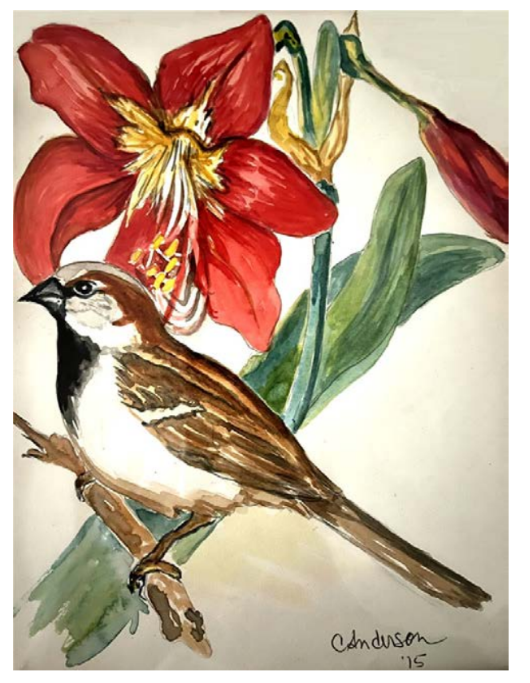 The House Sparrow originally inhabited a broad geographic region stretching across Europe and North Africa and throughout most of Asia except mainland China. It lived in close association with people in both rural and urban communities and is now often referred to as an “obligate commensal” of human beings, meaning that it is dependent on its human neighbors.
When large numbers of people fled Europe in the mid-19th century to live on other continents, many missed their familiar avian neighbors, including the House Sparrow. In the mid-1800s, 100 sparrows were brought to the United States from England aboard the Europa and released in Central Park. With the help of subsequent introductions, the species spread across the continent, making their way to the Pacific coast by 1915. Similar introductions followed in Australia, Argentina and South Africa. Range expansions increased widely from each of these sites so that today the House Sparrow is widely distributed on every continent except Antarctica.
The House Sparrow is not common on the the Samarkand campus, but a lone male does spend much of each day repeatedly chirping near the entrance to our Smith Health Center, hoping, no doubt, to attract a female to his chosen nest site. My favorite place for sparrow-watching, however, is Renaud’s. Carol and I each order one of their fabulous pastries and a cup of coffee and sit in the outdoor patio. There I watch the sparrows hop around under the
tables picking up crumbs that fall to the ground as patrons eat their pastries. Clearly sparrows have good taste!
Ted Anderson is a retired professor of Avian Biology, and the author of “Biology of the Ubiquitous House Sparrow” (Oxford University Press). The watercolor of the house sparrow (above) was painted by Carol Anderson, Ted’s wife.
Phila Rogers is now 96 years old and legally blind. She has decided to occasionaly have some guest columns of which this is one.


 Phila Rogers