FOR THE LOVE OF BIRDS

Ralph Hoffman begins the introduction to his wonderful bird book, “Birds of The Pacific States,” first published in 1927, with a paraphrase from one of Cicero’s orations extolling the delights of studying literature and how it enriches life.  Hoffman then paraphrasing further, applying Cicero’s words to the study of birds:

“It (the study of birds) develops keen observation in youth and is a resource in old age, even for the invalid if he can but have a porch or a window for a post of observation.  Birds become the companions of our work in the garden and of our walks…”

He concludes with:

”If a parent wishes to give his children three gifts for the years to come, I should put next to a passion for truth and a sense of humor, love of beauty in any form.  Who will deny that birds are a conspicuous manifestation of beauty in nature?”

I keep next to me my copy of “Birds of the Pacific States” given to me by my parents in the 1930s.  I was smitten with birds, thanks to my Girl Scout troop and the work we did towards our bird badge.  From experienced teachers, we learned the birds of the garden, and, on a nearby lake, winter waterfowl.  It is no exaggeration to say that my life was transformed forever.

My original copy of “Birds of the Pacific States”; a gift from my parents in the 1930s

And it may have been inevitable that in my old age I moved from Berkeley to Santa Barbara, Hoffman’s home where he wrote my treasured book.

His book has a way of truly experiencing a bird rather than simply identifying it.  A simple system of identifying a bird alone would have to wait for Roger Tory Peterson’s Field Guide to Western Birds, published first in 1941 (also given to me by my parents) where the salient features of a bird were indicated by arrows.  Further description was minimal, stating only that, in the case of a Brown Towhee: “A dull gray-brown with a moderately long tail; suggests a very plain overgrown sparrow.”
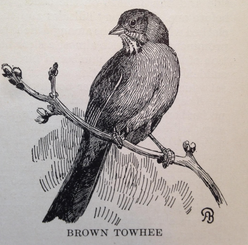
An illustration of a Brown Towhee from Hoffman’s “Birds of the Pacific States”

But read what Hoffman has to say about the Brown (now the renamed California) Towhee, a common bird found in the countryside and in most of our gardens:

“Can even a bird-lover become enthusiastic over a Brown Towhee – a plain brown bird that hops stolidly in and out of brush heaps…with no bright colors, no attractive song and no tricks or manners of especial interest? The bird is a rustic with the stolidity of the peasant and apparently lives its entire life near the spot where it was born.”

Hoffman from a “Natural History” article in 1982

Now there is the “essence” of the towhee!

And how grateful I was that within a week of arriving at my new home, I discovered a towhee scratching in the dry leaves.

Inserted into the pages of my copy of Hoffman’s book is an article from “Natural History” magazine written by Harold Swanton in 1982 titled “Ralph Hoffman: Unsung Guide to the Birds” subtitled “Early bird guides concentrated on birds in the hand: a New England schoolmaster produced the first for birds in the bush.”

The earlier publication in 1904 of Hoffman’s a “Guide to the Birds of New England and Eastern New York” was considered to be the first true bird guide.

After teaching Latin is several private schools in the east, Hoffman came west in 1919 to again teach Latin at the Cate School for Boys in Santa Barbara.  As a graduate of Harvard and the son of a distinguished Latin and Greek scholar, Ferdinand Hoffman, who ran a boy’s school in the East, Hoffman came by the classics naturally.

For the next six years, Hoffman lived in nearby Carpinteria where he had a clear view of the Channel Islands. The islands would draw him across the channel often, first to study birds and later plants. The northern-most island, San Miguel, would be where he met his untimely death.

View of the Channel Islands from Santa Barbara

The Pacific Coast was a new territory for Hoffman and he began almost immediately doing the research which would lead to the publication eight years later of the “Birds of the Pacific States.”

Hoffman’s home on Glendessary Lane in Santa Barbara

Swanton writes that “Hoffman had no formal training in ornithology or botany, and although he became an expert in both fields, he retained his amateur status.  He brought an amateur’s excitement and joy to his work, reflected in every line he wrote.”

Hoffman left teaching only when he was given the job as director of the Santa Barbara Museum of Natural History, an ideal job for a man who loved both teaching and the study of natural history.


Hoffman with Albert Einstein at the Santa Barbara Museum of Natural History

After the publication of his bird book, Hoffman turned his attention to botany. He took the opportunity on July 21, 1932 to go to San Miguel Island to pursue his study of buckwheat. When he failed to return to the group, after an eight-hour search in heavy fog, his crumpled body was found at the base of an almost vertical cliff. His broken trowel was found next to him. He evidently tried to use his trowel for support.

He is remembered especially at the Museum where a plaque memorializes him.  Though now found only through specialty booksellers, “Birds of the Pacific States”  remained in print for 50 years.

Joan Lentz, a Santa Barbara birder and author, agrees that Hoffman’s “Birds of the Pacific States” is one of the finest field guides every written.

For every lover of birds and nature, his book is an essential part of one’s library.

Up and Down California in 1860-1864: The Journal of William H. Brewer

William Brewer’s first view of Santa Barbara in 1861 was from the back of a mule. Brewer was part of the California State Geological Survey responsible for conducting a geological and topographic survey of the state, with an eye on identifying mineral resources.

upanddown1
The Survey Party

With gold fever having subsided, the new state legislature wanted to have a systematic survey of state’s resources. The well-known geologist, Josiah Whitney, headed the survey. William Brewer’s title was that of “Principle Assistant, in charge of the Botanical Department.” He was responsible for the fieldwork and for keeping detailed records of what was collected, measured, and observed.

With indefatigable energies, an insatiable curiosity, Brewer keep not only the field notes but managed a voluminous correspondence which became the basis for his journal: “Up and Down California in 1860 – 1864,” edited by Francis P. Farquhar and published by the Yale University Press in 1930. My copy, a beautiful edition generously illustrated, was inscribed to my father by Mr. Farquhar.  Mr. Farquhar at the time was the editor of the Sierra Club Bulletin and himself a mountaineer and author.upanddown2

William Brewer and his party departed from Boston, not on a sailing ship, but on a streamer bound for Panama. They crossed the isthmus by train to board another steamer for San Francisco. Like those before him and those after, he was overwhelmed by the beauty of the Bay and impressed by the substantial look of the young city. Brewer compared the early November day, to the finest Indian summer day on the east coast, “but without the smoke.“

From San Francisco, the party steamed south to San Pedro near Los Angeles. After leaving Los Angeles, they travelled north, exploring the coastal terrain, arriving at Santa Barbara region the end of February.

East of Santa Barbara, Brewer climbed a high ridge alone. He discovered a variety of shells weathered out of the rocks “as thick as any seabeach and in good preservation.”

I cannot describe my feelings on that ridge, that shore of an ancient ocean. How lonely and desolate! How many decades of centuries, have elapsed since these rocks resounded to the roar of breakers, and these animals sported in their foam … no human being was within miles of me to break the silence. And then I felt overwhelmed with the magnitude of the work ahead of me … doing field work in this great state, a territory larger than New England and New York, complicated in its geography.

They arrived at the town of Santa Barbara on March 7. The steamer was to leave that night for San Francisco. With only two steamers a month, Brewer comments on Santa Barbara’s isolation where only horse trails connected the community to other settlements to the north. The first, rough wagon road north would be completed later in the spring.

Brewer’s observances about the “decadent town” were much like Dana’s thirty years earlier.

The mission was founded about the time of the American Revolution – the locality was beautiful, water good and abundant. A fine church and ecclesiastical buildings and a town sprung up around. The slope beneath was all irrigated and under high cultivation – vineyards, gardens, fields, fountains once embellished that lovely slope. Now all is changed. The church is in good preservation, with a monastery along side – all else is ruined.

The first two weeks camping near Santa Barbara were most unpleasant (Brewer uses the word “abominable.”) The dense, wet fog meant tramping through wet bushes and thoroughly soaked their campsite.

Brewer describes riding along the beach with two locals, where they observed that asphaltum, a kind of coal-tar which oozes out of the rocks and hardens in the sun. “It occurs in immense quantities and will eventually be a source of some considerable wealth.” (But it was oil itself underlying the Channel that would be the source of wealth in the next century.)

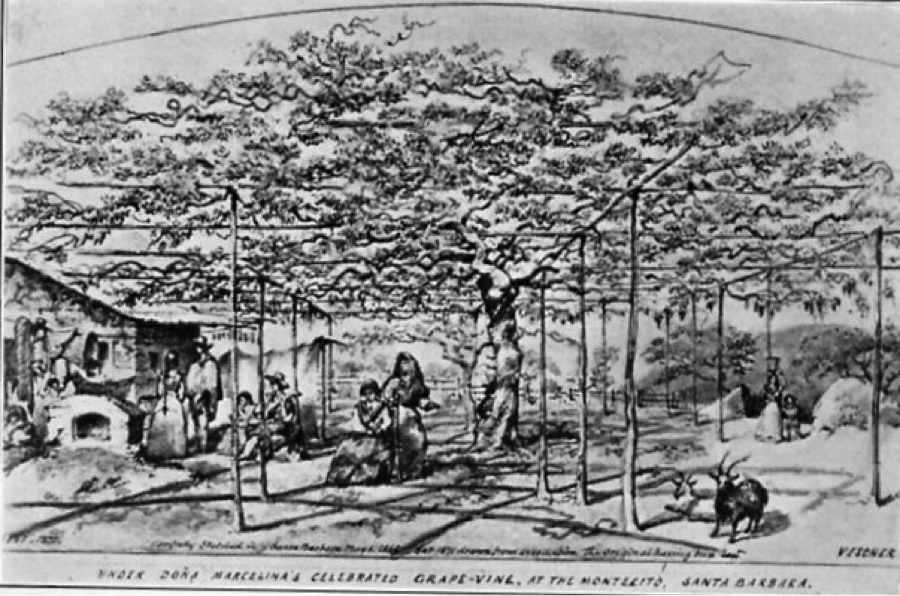
upanddown3Once the sun came out again, several of the party rode to the hot springs five miles east and took a refreshing bath in the hot waters, on the way passing “the most remarkable grapevine I have ever seen.”

With the return of the sun, Brewer and a companion set out carrying their barometer in its heavy box, climbing the rocky slopes to the highest ridge where the barometer would register the elevation.

Reaching the first peak, we struck back over a transverse ridge, down and up, through dense chaparral, in which we toiled for seven hours. This is vastly more fatiguing than merely climbing steep slopes: it tries every muscle in the body. We reached the summit at an altitude of 3,800 feet above the sea . . . . . I never before suffered from thirst as I did that day. The moon was bright as we struck down the wild, dangerous trail. Occasionally a snatch of song would awaken the echoes above the clattering of hoofs of the mules over rocks.upanddown6

Before leaving Santa Barbara, they joined in the celebration of Easter. The festivities of Holy Week, proved more irksome than pleasurable for Brewer as he had to extricate some of his men who had been jailed for brawling and drinking.

The survey continued its work traversing the state in all directions before returning to Boston in late December 1864.

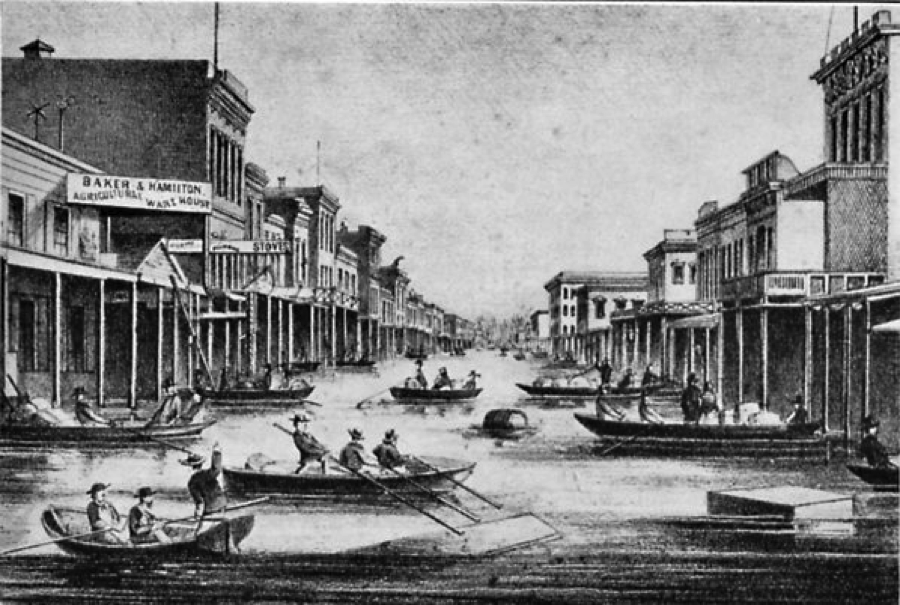
During his almost four years in California, Brewer experienced back-to-back the wettest and driest years on record. During the winter of 1863, The Central Valley was under water. Crops were destroyed and cattle drowned.

upanddown5The following year was desperately dry. On May 27, 1864 he writes:

We came on up the San Jose Valley, twenty-one miles. The day was intensely hot, 97 degrees, the air scorching and dusty. The drought is terrible. In this fertile valley there will not be over a quarter crop, and during the past four days’ ride we have seen dead cattle by the hundreds. The hot air trembled over the plain, and occasionally a mirage seemed to promise cool weather, only to vanish as we approached.

William Brewer returned to the East Coast and a successful academic career at Yale. He married again and fathered several children after losing his first wife and newborn son, shortly before departing for California.

Though the survey was a disappointment to some as it is doubtful that the results led to immediate economic gain, much was learned about the mining regions. According to Francis Farquhar in the introduction to the book, “ … great progress was made toward the understanding of the geological history of the country.”


Grasslands

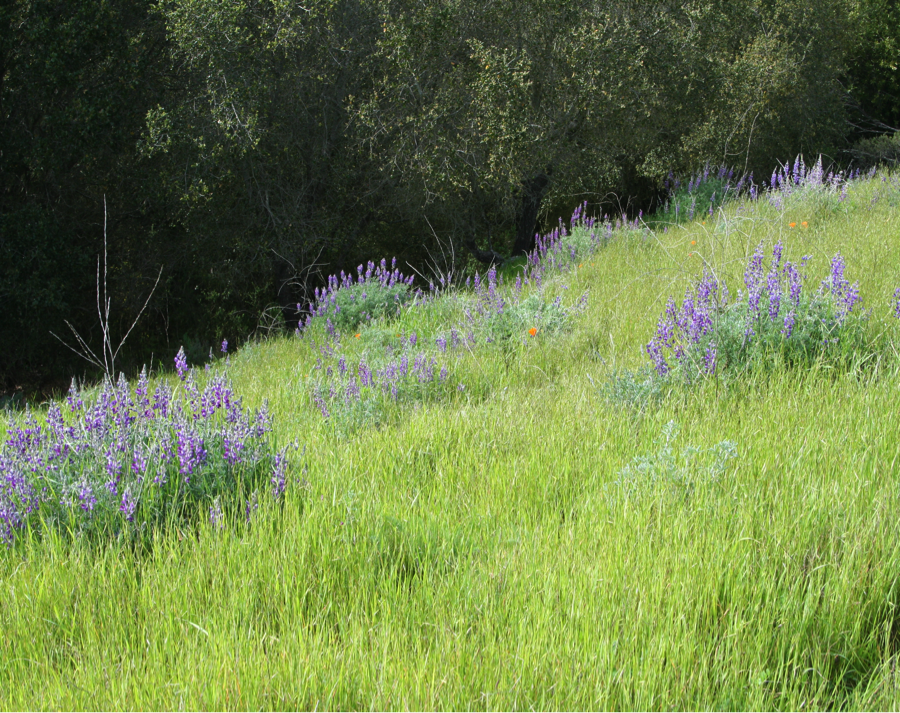
No other plant community speaks more poignantly of the California seasons than the grasslands – emerald green in the winter and early spring and tawny gold in the summer and fall. And in the undulating, rippling sea of grass you see the wind’s signature. Once, a quarter of the state was covered by grassland. But what I celebrate today is profoundly different from the grasslands before the arrival of the Europeans in the late 18th century.

The native perennial grasses have been mostly replaced by the imported European annuals, like the wild oats, whose seeds were often embedded in the fur of the long-horned cattle brought by the first Spaniards and Mexicans. The predominately native perennial grasses were not adapted to the heavy grazing pressure. As the native perennials declined the European annuals moved in. Grasslands, more than any other plant community, were affected by the arrival of the newcomers

The Bear Flag, the flag of the brief-lived republic before California became a state, shows the long-gone grizzly and the native perennial grasses which grew well spaced from one another. Spring wildflowers put on their annual display in these open spaces.upandown7

By the time William Brewer and the survey arrived in California the grasslands had been irrevocably altered.

Those interested in restoration have reintroduced bunch grasses in certain areas finding that redoing is slower business than the original undoing.

                              *                        *                       *

upanddownAs a child, I reveled in grasslands. In the spring I rolled in the grass, staining my clothes green. I loved the pliant blades, and how green grasses held a trace of moisture even on dry days. I was soothed by the grassland simplicity, not yet understanding its complexity, seeing only an undifferentiated sea of blades. I liked that grasses accentuated the curve of the hills rather than hiding the contours under a coarser cover.

In the summer-dry grass, I would search for singing crickets, but they always stopped singing with my approach. The wind hissed in the dry stalks and picked up the seed-bearing fluff of dandelions carrying it off to new places. Dry grass, even though now lifeless, smelled sweet, like remembered barns full of hay.upanddown8

Before dying back, grasses had cast out their seeds, which lay dormant, until the first rains in the fall coaxed open the hard seed liberating the first tiny blades of new grass. During the rainy months of winter, the lengthening grass spread over the hills like a green tide.

The Other Side of the Mountain

From my bedroom windows, I look up at the rocky wall of the Santa Ynez Mountains. The mountains rise twice as high as the Berkeley Hills, so much higher than I’m used to that I’m always startled when I see them. While the Berkeley Hills are dense with houses and green with planted trees, the Santa Ynez are mostly bare stony ramparts with thin patches of gray-green chaparral.

The only way to penetrate the mountains is through the narrow canyons carved out over time by running water. Even then, the going is rough requiring boulder hopping and at times squeezing through almost impenetrable thickets.

The mountains do have their gentler moments when the chaparral blooms briefly white in February and then pale blue in April. Sometimes in the winter the rocky face is laced with waterfalls which disappear in a day.

Late in the day when the low sun slants across the mountain face, shadows fill the canyons and the mountains look soft and approachable. At sunset, the mountains have their finest moment when the alpenglow suffuses the peaks with orange as if the mountains were being heated from within.

The rest of the time, the south-facing mountains, under the unrelenting sun, look harsh and forbidding. For relief, my eyes invariably trace the high ridge where a broken line of green conifers look like miniature cones from the distance. I learned that they are the drought-tolerant Coulter Pines which produce monster cones weighing up to eight pounds (maybe the largest in the world) while hanging on to their anchorage in such an inhospitable place.

IMG_1698
A Coulter Pine

Since coming to Santa Barbara almost 9 months ago, I have been eager to see them up close. My grandson was game for the trip, so last week on a bright sunny morning we drove up San Marcos Pass (called route 154 on the road map).

In ten minutes we were at the right turn to East Camino Cielo. The narrow, but paved road, passes first through a dense, shady grove of madrone and tanoak trees like the groves I had last seen at Mount Tamalpais, in Marin County. I learned that this was indeed the southern-most outpost for these species.

And could those trees be Big-coned Spruce, growing dark and ragged on that distant, steep north-facing slope? If so, this may be the northern limits for this tree, so familiar to those who frequent the mountains of southern California.

Closer at hand were other surprises. What’s this? A small cottonwood with shining leaves vibrating in the breeze?. Cottonwoods belong near water. What is it doing in these sere mountains. Maybe the crease where it was growing is a moist seep hidden from view.

A few plants are still blooming – the golden-petalled monkey flower, the red blooms of the hummingbird sage. Manzanitas which had bloomed in late winter now bear the round green fruits whose Spanish name means little apples.

And more surprises, sword ferns in the shadiest, most protected places. Scattered about are young big-leaved maples, another moisture lover, which bring a touch of gold to the fall landscape.

IMG_1697

This transverse mountain range running east to west contrary to most of the coastal mountains, is truly a “Hadrian’s Wall” a kind of “don’t cross” line separating certain Northern California flora from Southern California flora. Those plants requiring more moisture can make it on the lee-side of the ridge where fog drip and heavier rainfall meet their needs.

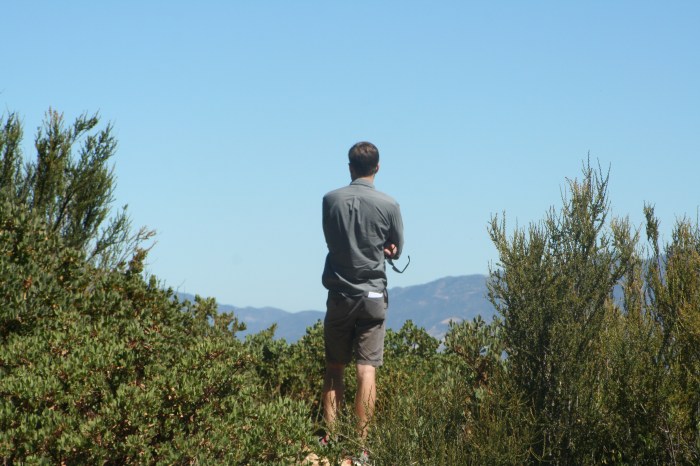
Absorbed as I am by my immediate surroundings, I remember to look up to take in the superlative views – north to the higher inland ranges like the San Raphael’s and the south over the Channel, half-lost in the summer haze. I could just make out the slumberous profile of Santa Cruz Island on the horizon. Most arresting of all was the view down into the drainage of the Santa Ynez River where steeply-sloping hills are so dry and thin-soiled that almost nothing can grow there. I wonder if even abundant winter rains could touch them with green.

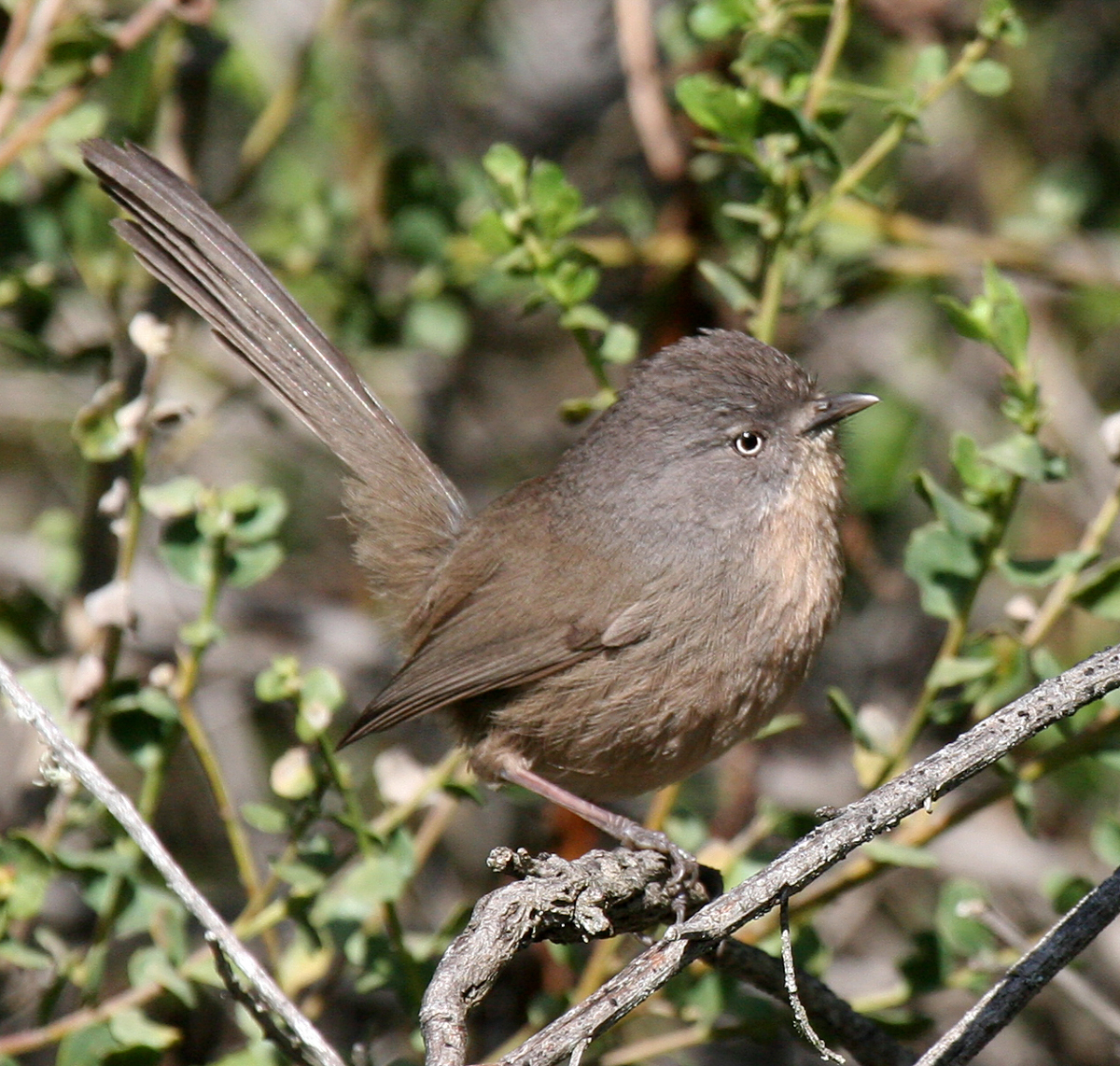
The air was both fresh and still, the silence profound, with only a calling wrentit to disturb the silence. How divine it would be to camp here, to see the wheeling constellations and to watch a sunrise. But the nearest campground is some miles away down along Paradise Road which parallels the river, but with none of vistas offered by this highest ridge of the Santa Ynez Mountains.

Wrentit. Photo Credit: Bob Lewis, wingbeats.org

I am thinking of my father as a boy, in the framed, black and white photograph of him and his dad which hangs in my daughter’s office. He is a lad, perhaps twelve years old, and like his father holds a rifle at his side. Wearing a slouch hat with his trousers tucked into his high laced boots, he looks utterly happy to be out on a trail in these same mountains. A boy and his dad with their guns. I neglected to ask him before he died whether he sometimes saw condors. In the early 1900s when the photograph was taken, they would have been riding the thermals over the wilderness back country.

Half of me still lives in my memories of Northern California where the hills and mountains are so different. Instead of sharp, irregular profiles against the sky with their “bones” revealed, “my” hills and mountains are curvaceous, voluptuous, plump, and most often further softened by a covering of grass. Where a hill curves inward, toward its neighbor, the seams are filled with dark green live oaks and bays.

My daughter, when visiting Berkeley, would always mention what she saw as the cool, blue light and rumble of the cities below. I often felt caught between her love of Santa Barbara, and my father’s preference for “the brisk, invigorating Bay breezes” which seemed to energize him. He was not a fan of laid-back Santa Barbara and its soft, silken air. He rarely returned, and I sensed always with reluctance. I sometimes wonder what he would think, knowing that his fellow, nature-loving daughter had forsaken the vigor of the Bay Area, for this somnolent place.

Back in Santa Barbara in time for lunch, it required effort to reorient myself after only two compressed hours in such a high, wild place. I plan on returning often, heartened by how close I am to wilderness.

Making It Work on the South Coast

I don’t think I could have written these words even two months ago because I was still unreconciled to my move to Santa Barbara. This is NOT my home, I would have told you. And then I would begin my rant. Where are the robins to sing up the dawn? Where are the chickadees chattering in the oaks, or the Great-horned Owls hooting at dusk from the eucalyptus?

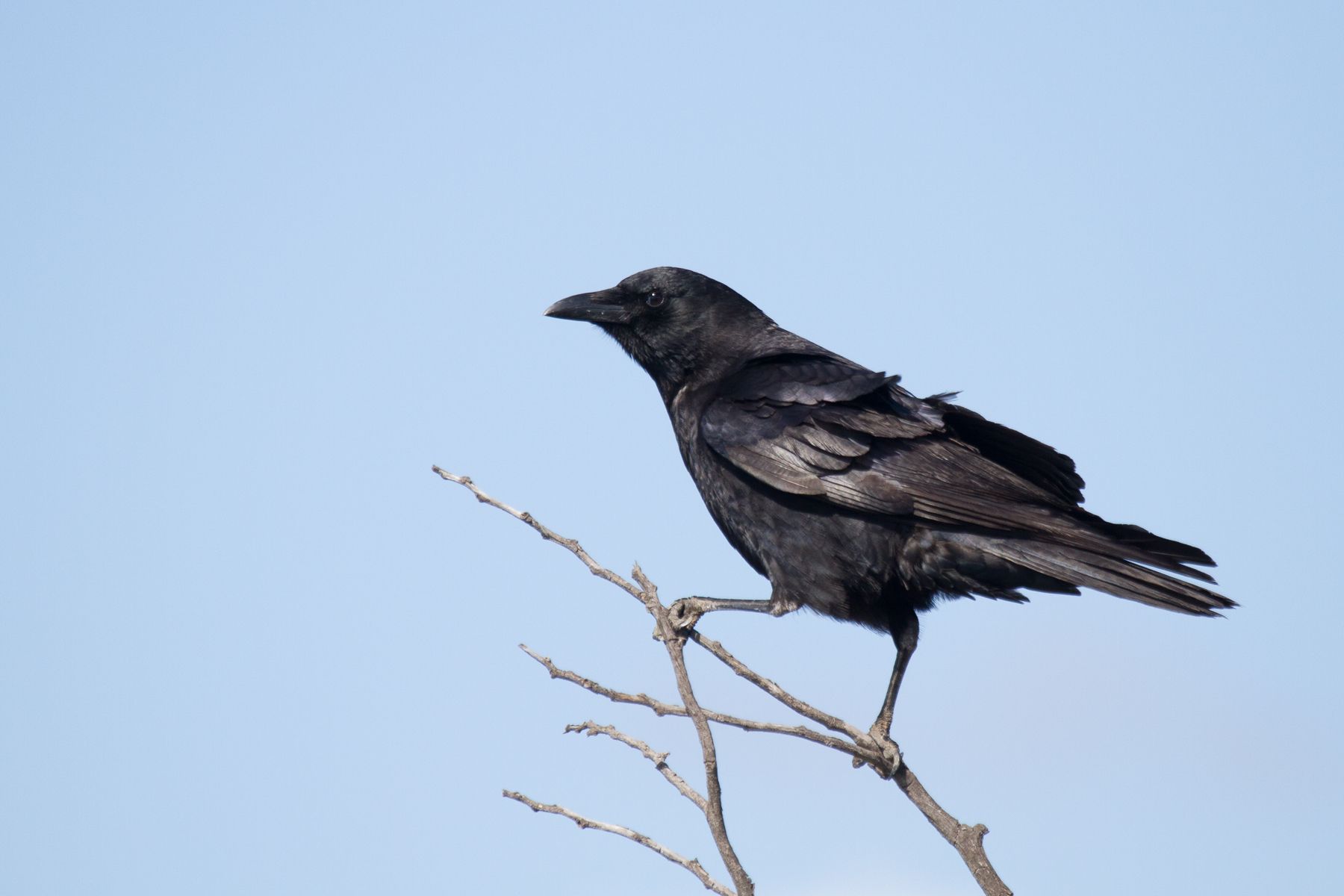
Nothing was right. Here, it is a cacophony of crows – an unholy chorus – from dawn to dusk. The creek next to this retirement “campus” is dry as a bone, lacking the lush streamside vegetation to attract the spring singers like the Swainson’s Thrushes, Warbling Vireos, and Wilson’s Warblers that populated my beloved Strawberry Canyon.

American Crow. Photo Credit: Bob Lewis, wingbeats.org

Some days, I would imagine sitting on the bench under the sheltering branches of the oak I had planted 60 years ago. Or I would envision myself at the U.C. Botanical Garden, climbing the path up to the Old Roses garden, and to the fence line where I could look up the steep chaparral-covered slope to the bent tree at the top of the hill. Coming down, I would stop to view the Bay in the “V” of the hills. Of course, there would be robins singing everywhere, and the Olive-sided Flycatcher calling from its perch at the top of a redwood.

There’s no cure for this nostalgia other than to acknowledge that I will always look at what’s around me through Berkeley eyes. I don’t want to surrender that perspective. But maybe I could allow myself to consider the virtues of the South Coast, of Santa Barbara where everyone wants to come and visit and — if they could afford to – stay.

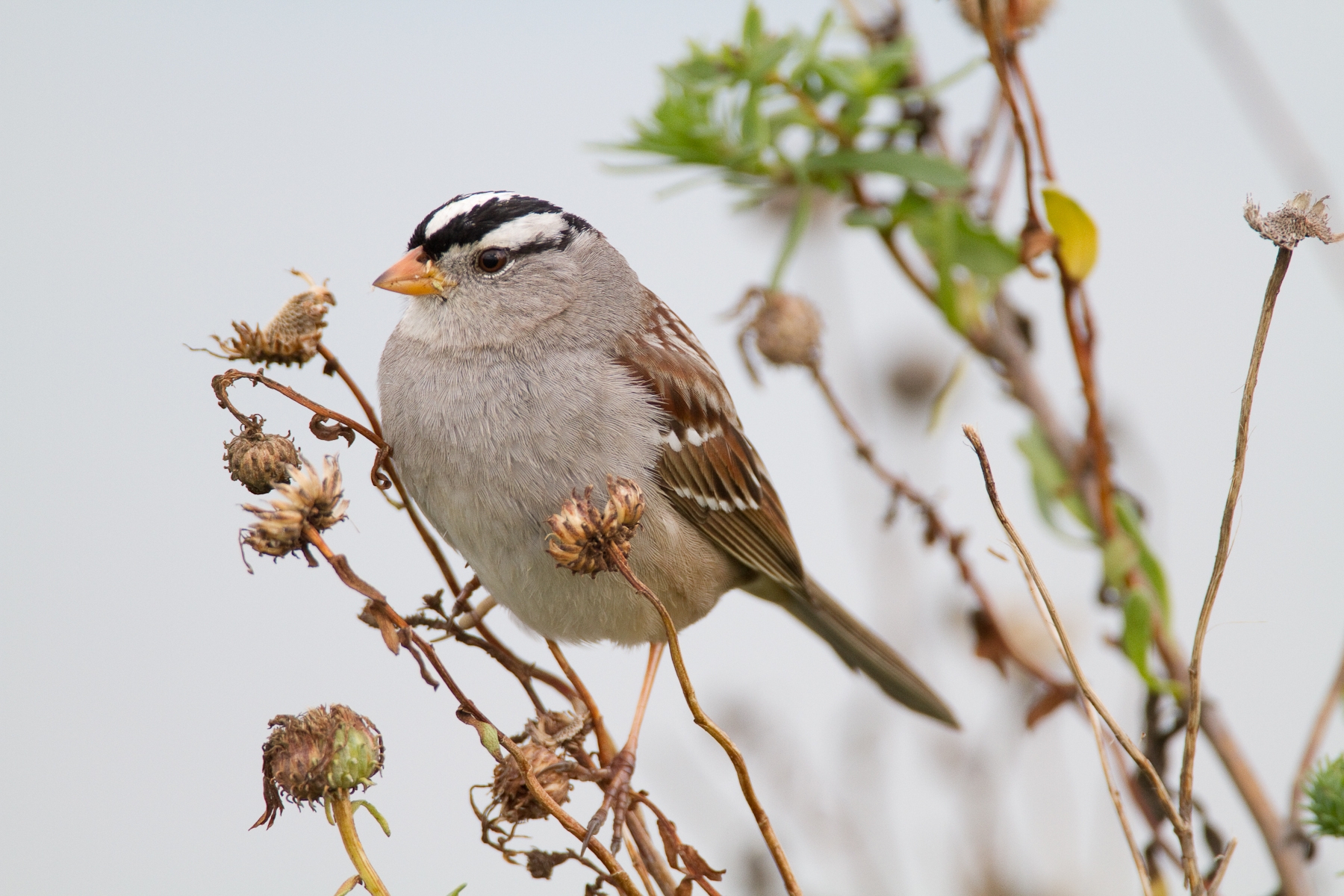
A month after I came to live here last September, flocks of Yellow-rumped Warblers arrived, just like the ones in Berkeley. The manicured gardens of lawns, palms, and agapanthus beds were just fine with them. They dove into the palms and out again, forever “chipping.” Then a Hermit Thrush took up winter residency beneath the live oaks below my bedroom window. And then a troupe of cheerful White-crowned Sparrows arrived, singing sweetly, but in a different dialect.

White Crowned Sparrow. Photo Credit: Bob Lewis, wingbeats.org

My retirement community is just up the hill from Oak Park, one of the scruffier city parks but with some fine live oaks and sycamores. Sycamores are new to me except for the ones I would infrequently see out around Sunol where they favored the flats near streams. They are the true eccentrics in the plant world – no two trees alike. Gravity often has its way with them, pulling long branches in deep curves that almost reach the ground, while other limbs look to the sky and grow upward in search of the sun. The trunks near the ground are often covered with thick, brown bark that gives way to thin plates of bark that continually shed, revealing patches of pale brown, gray, olive, and bright russet in newly exposed areas. I am always reminded of a pinto pony. The upper limbs — rising high above the companion somber live oaks — are almost pure white, especially stunning against a blue sky.

Sycamores are attractive to birds partly for the opportunities they provide the cavity nesters. The larger holes invite woodpeckers and owls, with the smaller holes attracting House Wrens, nuthatches, bluebirds, and many others. Certain species of hummingbirds gather the down under the leaves to line their nest, while those winged beauties, the tiger swallow butterflies, leave behind eggs that become the voracious caterpillars that find the big palmate leaves to their liking.


Sycamore Limbs.
Sycamore Limbs.

Mission Creek, considered the only perennial stream in the area, borders the park. But this part of the creek, a mile or so from where it enters the ocean, is always dry this time of the year. Only once during this record dry winter did a good rain fill Mission Creek with a wild white-and-tan froth of racing water. From its bank, I could hear the torrent rearranging rocks in the creek bed. The next day, the flow had slowed to a few reflective pools connected by a trickle of running water. One day later, the water had disappeared – gone! And it’s been dry ever since.

I walk down the hill to the park most days, crossing a bridge where I often stop to examine the placard describing how the creek bed has been restored by removing tons of concrete that had acted as a barrier to the passage of the endangered Southern Steelhead Trout. In better times, the fish might have entered the creek from the ocean during winter storms, ascending the creek to spawn in the upper watershed where water remains year round. But not this year. Even the upper watershed in the Botanic Garden has been reduced to a few stagnating pools, with only the thinnest trickle of water in certain places.

Sometimes I drive up into the foothills to visit the Botanic Garden, which like the one in Tilden Park is devoted exclusively to plants native to California. The upper part of canyon has its share of live oaks, small bays, and towering sycamores, but none of the dense riparian vegetation to attract the streamside breeders that fill Strawberry Canyon with their joyous songs.

Many of the birds in the south coast canyons are the ones you might expect to see inland in the Bay Area – Acorn Woodpeckers, White-breasted Nuthatch (instead of Red-breasted), Phainopeplas, sometimes Canyon Wrens, and Wood Pewees. Stellar’s Jays are seldom seen in the lower elevations. Swainson’s Thrushes pass through in migration, only breeding in the rare streamside where the vegetation conceals this shy bird that mostly reveals its presence through its song.

Acorn Woodpecker. Photo Credit: Bob Lewis, www.wingbeats.org
Acorn Woodpecker. Photo Credit: Bob Lewis, http://www.wingbeats.org

Today I visited such a place – Atascadero Creek in nearby Goleta, which is tidal below its check dam. But above the dam, its fresh water section supports a jungle of willows, cottonwoods, a few small live oaks, and the first Big-leafed Maple I’ve seen since coming south. I heard two singing Swainson’s Thrushes, several Wilson’s Warblers, a singing Black-headed Grosbeak with a begging juvenile.

Here at the retirement place, House Finches continue to build nests on any flat surface and the Lesser Goldfinches empty my feeder in a day. But the Orange-crowned Warblers, which sang until a week ago in the park, have ceased singing, confirming that the summer doldrums will soon be upon us with few surprises in the bird world and the uninspiring sequence of daily fog and sun.

Time to look to the local beaches, where shorebirds are beginning to move along the coast. Shorebirds, mostly gray or brown during the winter, are my weak link. With my Sibley open, I’m trying to bone up on leg length and color, beak differences, feeding habits. Best idea is to find a walking companion more knowledgeable than I.