The Man Who Loves Fig Trees

Moreton Bay Fig Tree, Santa Barbara

When the Native Plant Garden was installed five years ago, it was decided to leave the old fig tree, although it wasn’t a California native. The tree managed to survive on its lean ration of water. Several months ago new neighbors moved into Eastview, Marty and Magdy Farahat, she a doctorate in music and a flutist and he a retired nuclear engineer. He had been raised in Alexandria, Egypt, a place with a similar climate to ours with a rainy winter and a long, dry summer. Thanks to our long, wet winter, the fig developed a new set of large green leaves. Magdy was inspired to introduce a potted fig to his patio. He also successfully rooted a small branch from the tree. Here was a man who clearly loved fig trees. The fig, an ancient species from Asia spread to the Mediterranean world where for centuries it was revered by the Roman, Greek and Egyptian cultures. In a unique arrangement, the fig fruit itself contains its flowers which are pollinated by a tiny fig wasp that slips into the fruit with pollen on its wings. To add the pleasure of scent to his patio, Magdy found an Arabian jasmine (Jasminum sambac) a local nursery. Its exquisite fragrance pervades the neighborhood of Eastview.

How to Create an Extra Room

The Blooming Mandevilla confirms Saundy’s green thumb!

Balconies aren’t always used for growing plants, they can also be arranged to create illusions. This is what Saundy See has done with her balcony at Magnolia East.

Saundy is a dynamo who arrived at Samarkand earlier this year via Des Moines, Iowa and most recently, from Carpinteria. It doesn’t take long to recognize talent and within two weeks she became the buyer for the Samarkand Treasure & Talent Gift Shop and soon after, the manager, being eminently qualified by her experience owning a card and gift shop in Des Moines. Evidently this new enterprise wasn’t enough to absorb all that energy so she also offers experienced dog and cat care.

Saundy’s Balcony

The photos tell the tale about Saundy’s sleight of hand in her new home.

Notice the balcony chairs turned inward toward the living room while most folks might turn them outward toward the view of the ancient Magnolia tree which, along with the blue urns and the koi pond, date back to the site long before Samarkand became a retirement facility.

Beginning Again — The Native Plant Garden in Early Summer

I had written a nice enough short piece about the native plant garden in early summer to run on my website, and then the piece disappeared from my computer—forever.

I had commented on looking down into the garden and seeing a scattering of California poppies and two white flower spires, the last of the “candelabras” on top of the buckeye tree.  The buckeyes growing on the drier slopes around lowland California are one of the only trees which drop their leaves in late summer rather than in the fall.  The buckeyes are not preparing for winter like most deciduous trees but to avoid the heat of late summer and early fall.  Their large thin leaves can’t take the heat.  But once bare, there is a new beauty to behold – an intricate design of smooth, light gray crooked branches. Donald Culross Peattie in “A Natural History of Western Trees” calls the California Buckeye “an oddly lovely tree.” 

Happy is the hiker who carries a dense smooth buckeye seed in one pocket and a sprig of fragrant California sage in the other.

What I can’t see looking down from my bacony is the bright fuchsia and white splash of color of the clackias (“farewell-to-spring”)– usually the final wildflower display of the spring wildflowers.  This has been a banner year for wildflowers following the winter of generous rains.  Now is the season for the pungent sages and the color purple.  Sturdy bushes of “Alan Pickering” salvia with its powerful aromas must be a clarion call for pollinators.

The garden is shutting down for the season with the quiet business of ripening berries in the sun and roots searching for pockets of moisture.

Seeing the surrounding gardens of bougainvillea, birds-of-paradise and hibiscus, folks complain about the native garden as being “drab.”  I like to sit quietly on a bench and watch the antics of the fence lizards doing their pushups or waiting for the quiet drift of a butterfly which, like the birds, find the garden more interesting than the cultivated ones. Animals come to the garden, too.  A bobcat passes through and once a mountain lion made a brief appearance.

I like the idea of matching our natures to the natural rhythms of nature itself.  
And I can’t resist commenting on the unusual weather (is there such a thing as “usual” weather?)  It appears that the long, cool wet winter has slid almost seamlessly into a cool moist early summer with an abundance of clouds.  In the Sierra, the days remain in the low 60s with regular afternoon showers and in the Central Valley the temperature rarely rises above 80 degrees, a welcome relief from the normal summer heat.  Here on the coast, it is best described as gloomy and grayer than usual. This pattern is likely to change soon.

Two Red Rocking Chairs

Sylvia’s Patio by Sue Fridley

As you approach the entrance to buildings Northview and Westview, your eyes may be drawn to two red rocking chairs on a small patio in back of Sylvia Casberg’s apartment. The patio is surround by a simple wrought iron fence and a gate that is always open. Potted red geraniums hang from the eave and two beautiful wind chimes make music in the lightest breeze. A curving pathway of crunchy white gravel leads to the street. A white pottery birdbath attracts birds and the attention of photographer Tom Ginn. In early summer the garden features a bird of paradise plant surrounded by California Poppies and orange nasturtiums. Later, saucer-sized red- orange hibiscus attracted watercolorist Sue Fridley, whose painting is featured here.

Asking about Sylvia’s early garden experience, she said, “As a child I was encouraged to grow a Victory Garden but only radishes came up which I figured weren’t going to win a war. I had better luck when nurseries began offering small plants. I talked to the plants reminding them that ‘you grow or out you go.’”

Male Western Bluebird on Sylvia’s Birdbath (Photo by Tom Ginn)

If you walk by early in the morning, you may see Sylvia wrapped in a blanket enjoying a cup of coffee. Later in the day it might be a glass of wine sipped as she enjoys the sunset.

A Garden at Each End

Eastview is a bit of a loner, located at the far southeast corner of the Samarkand property. The live oak trees from Oak Park climb up the slope to provide a protective background around our Native Plant Garden. L-shaped Eastview with its porches and patios complete the sheltering of the garden within its two wings.

On their porch, Joyce and Allan Anderson have assembled a whimsical collection of pots and mostly succulent plants. Even the walls and doors showcase unusual art pieces, but what is so special is its location under the jacaranda trees with their lacy leaves which filter the western sun. A table and chairs provide a beguiling and private spot for taking meals and entertaining friends. And once a year the jacarandas produce trumpet-shaped flowers which retain their purple color even when they fall to the ground. Joyce also provides flowers and seasonal decorations for the Eastview mailbox area.

My own garden is at the opposite end of the building where the light from the north is limited and the sun withdraws completely in the winter. My solution is to hang red ivy geraniums over the railing and to put large pots of lushly green sword ferns on the floor. At the end of the porch, facing a mountain view I have a chaise for napping, reading or doing nothing. A fountain against the east wall provides pleasing music.

What have you created on your patio, balcony or garden area? Contact me if you’d like to share!

Nancy Keele and Her Garden

Nancy Keele and
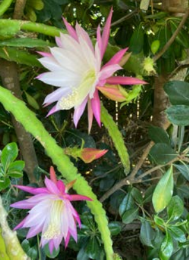
Orange Sherbet Epiphyllum

Nancy Keele lives in one of the cottages referred to as a Southview villa.  Unlike most residents at Samarkand who have either a balcony or a small patio, Nancy has both a small front yard and a rear garden which includes a handsome Canary Island Date Palm where she raises her Epiphyllums.

As told to Phila Rogers (SamNews September 2022)

When I look out into my beautiful gardens, I can’t help but think of my mom, and her influences on my life. She gave me my first two Epiphyllums (“Epies”) and put me on my first pony. As I grew older, to help me develop talents, she agreed to take me horseback riding monthly if I practiced the piano daily.

As an adult I fell in love with the Epies; my collection numbering above 100 before my move to The Samarkand.

Mystic Mood

I fulfilled my dream of having a horse by owning a 13-acre ranch on San Marcos Pass where I bred, raised, and trained Arabian horses. I exhibited in many shows throughout California.

I was the Choral Music director at Santa Barbara Junior High, and at La Colina Junior High School, where I was also involved with Music Theatre productions.

My front walkway garden is lined with Epidendrums, Cymbidiums, and succulents. However, the Epiphyllum “stars” are in my back patio garden. In nature they grow in trees; I grow them in nursery pots. Blooming season is in the spring (March through June).

Impossible Dream
Strictum
Lavender
Anna Purina

Finding Solace

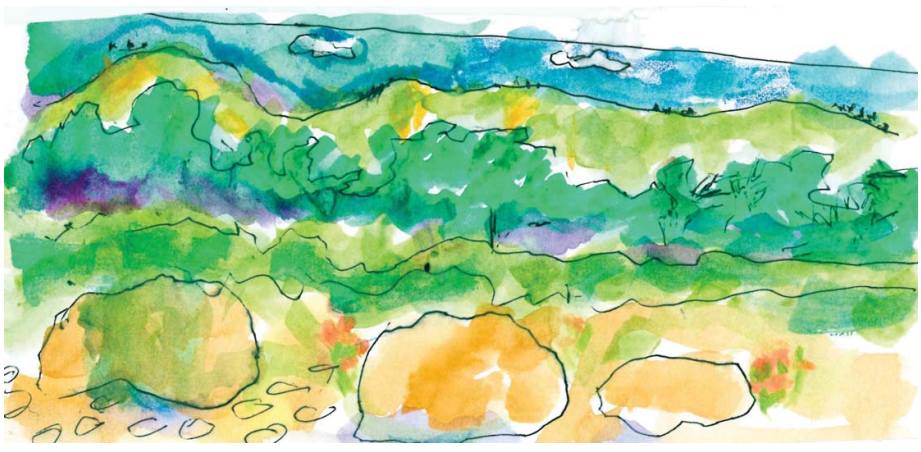
On those days when my mind gets stuck on negative thoughts, I leave my apartment and walk down to the Native Plant Garden. Sitting on the bench, I listen to the soft gurgle of the water flowing out of the top of the sandstone boulder, knowing that in a few minutes birds will arrive for a drink or a bath.

My eyes follow the green slope of plants to the far edge of the garden where a row of dark green California Live Oaks separate us from Mission Creek at the bottom of the hill.

This is your land, our land, and the plants that supported the generations who came before us. Oak acorns ground in stone mortars produced the staple food for the Chumash Indians. I look up to the high mountains to the cliffs of sandstone like the rock in front of me and to the areas of gray-green plants many of which grow in our garden. And then the sky, always the sky, and I am deeply comforted by this enduring landscape.

FOLLOW BLOG BY EMAIL

Enter your email address over on the right to follow this blog and receive notifications of new posts by email.