Once Upon A Time

I take pleasure in thinking about the Santa Barbara of 500 years ago, before the arrival of the first traders and the mission builders. From the breakwater, I look to the city and the mountains, mentally removing buildings, roads, railroads, and all other signs of human habitation except for a scattering of thatched huts of the original Chumash tribes. As hunters and gatherers, they lived lightly on the land.

Now I will take away all the non-native vegetation. Yes, that includes the palms, which are native only to Palm Springs oases; the eucalyptus, olive and pepper trees; the purple-flowered jacarandas; and all of the other non-native species which later found Santa Barbara to be a suitable home.

I now can see the bones of the landscape, the boulders and rock outcroppings. And the many creeks, most originating in mountain springs and fueled by winter rain. The creeks flow rapidly downhill and when reaching the flood plain, meander to the ocean.

The gentle sloping plain and surrounding hills are an oak savanna covered with grasses and scattered coastal live oak – a perfect habitat for grazing deer, elk and antelope who are stalked by wolves, mountain lions and grizzly bears, the most massive mammal of all.

In today’s Santa Barbara, the distant howl of a coyote or a rare sighting of a mountain lion reminds us of the wild past of our unique locale.

Montecito Peak – My Volcano

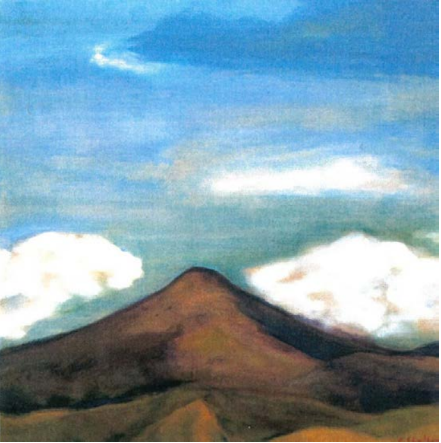
I have a fine view of Montecito Peak from my east-facing windows. Perched at the south end of the Santa Ynez mountains, Montecito Peak is shaped like a cone, while the rest of the range, with its sheer cliffs and rock outcroppings, has an undulating profile against the sky.

Put a fragment of cloud on the top of the peak and it’s easy to believe that an eruption is imminent. Magma, which heats the Montecito Hot Springs, is nearby, but a geologist friend assures me that the range, including Montecito Peak, is composed mostly of sandstone that is full of marine fossils from the time when the land was covered by a warm sea.

Montecito Peak with its 3,214-foot summit is definitely worth the climb as you have an uninterrupted view of the coastline from Oxnard to Refugio once you reach the top. Though not a climber, I depend on whether Montecito Peak is visible or not to tell me what kind of a day to expect.

Karin Shelton is a Santa Barbara painter and this image is from one of her note cards. Some of her paintings are on display in the Life Center at the Samarkand.

Looking South to the Ocean

I lived most of my life in the Berkeley Hills where I looked west through the Golden Gate knowing that it is the only sea level break along the coastal mountains. At night, two lighthouse beacons told me where I was – one flashing light on Alcatraz Island just inside the Gate and the other 25 miles offshore on the Farallon Islands.

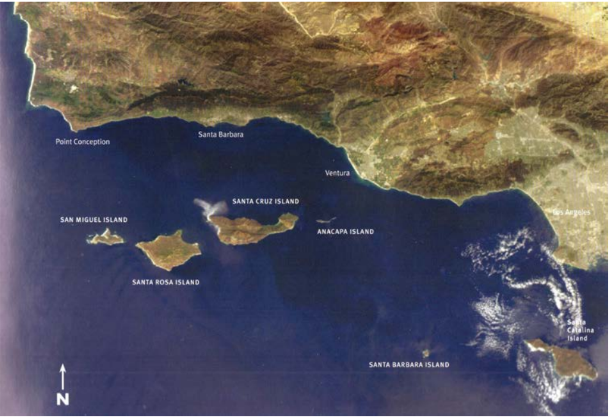
When I first came to Santa Barbara, I looked for what might be special. I admired the mountains at the edge of town which are twice as high as the Berkeley Hills. Then l remembered that in Santa Barbara you looked due south to the ocean because 30 miles west at Point Conception, the coastline turns abruptly 90 degrees east. Near Ventura the coastline straightens up again and resumes its roughly north/south trend of the rest of the California coastline.

On clear days I can see the profiles of Santa Cruz and Santa Rosa Islands which are part of the five Northern Channel Island group, giving Santa Barbara another distinction in a state with few offshore islands.

And how about another fact: it is the motion of the San Andreas fault over time that has twisted the coastal mountains in the region to also run east/west, which is why on the maps they are referred to as the Transverse Ranges.

But aside from all the interesting geology, what I truly love about the mountains behind Santa Barbara is the way they reflect back the low winter sun to help give us the mild winter climate.