On Growing Up in Santa Barbara – SHIRLEY ROBY

Shirley Roby was born at Cottage Hospital in 1942. Home was just around the corner near Oak Park. Before she was a year old, she and her parents moved to Hillcrest Road on the back side of the Riviera. The home had generous gardens, a pond and is still the family home, presently occupied by her daughter and husband.

With no school bus serving children in the hills, most mornings Shirley traveled down the hill to Jefferson Elementary School with her father, who was a banker in town. Her mother was a local historian who wrote regular columns in the Santa Barbara News- Press and authored a book about the Santa Barbara Fiesta.

Shirley started playing the violin at 5 years old and, like Alita Rhodes, played in the city-wide summer orchestra and went to YWCA camps at Pine Mountain and on Catalina Island.

After graduating from Santa Barbara High School, she headed north to attend Lewis and Clark College in Portland, which is where she met her husband-to-be, Kib.

The Eastern Sierra drew the family away over the years, first to Lake Mary and then to – Lake George. Later, Shirley and Kib (assisted by their two children) owned and operated the Rock Creek Lodge – at 9,300 feet, a popular jumping-off place for hikers and fishermen.

Sandstone — Santa Barbara’s Backbone

When I got to know fellow Samarkand resident Irene Coker, I learned she had her own Santa Barbara story. Though born in Santa Barbara, she grew up elsewhere, returning when she was 18 years old. But her great-uncles had come to Santa Barbara years before from Italy, working first as gardeners in Mission Canyon and then later as stone masons, constructing walls near the Mission.

It was the talented stone masons from Italy who gave Santa Barbara its distinctive look with their handcrafted buildings, walls and bridges, many made using our local sandstone.

A trip to the Santa Barbara Botanic Garden in Mission Canyon will show you even earlier uses of sandstone. In a climate with a short rainy season, the Mission Fathers realized they would have to store water to see them through the long dry season. You can still see the dam built by the Chumash people in the early 1800s under the supervision of the Mission Fathers. The water was impounded by the dam and later traveled down to the Mission gardens via aqueducts. At the Garden, you can also see one of the immense boulders brought down from the mountains in an earlier debris flow.

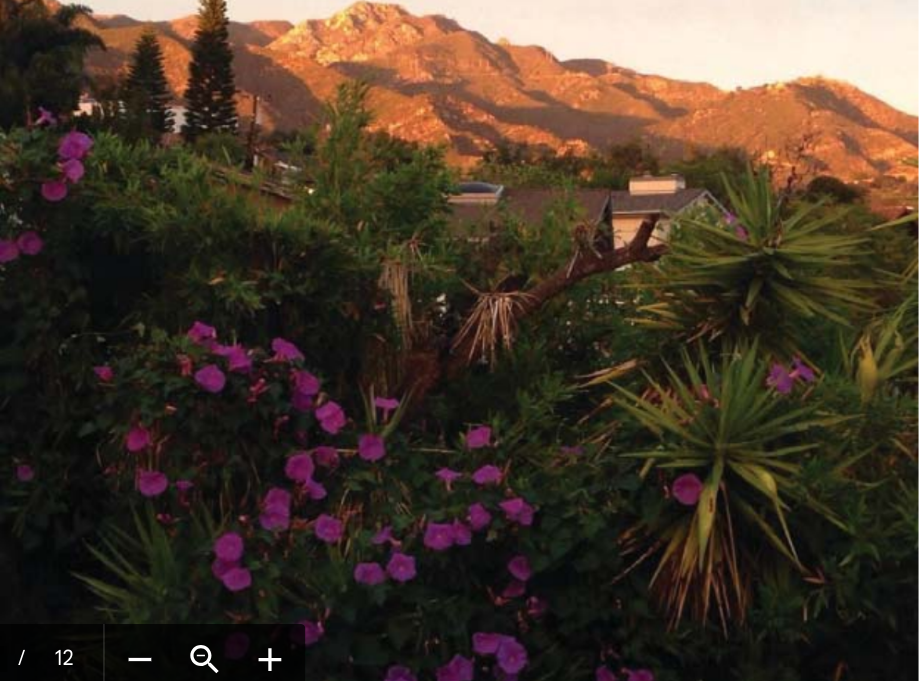
I love the sandstone features all over town, I’m glad most of the sandstone remains on the mountain slopes, because when we walk at the end of the day the setting sun turns the sandstone a glowing orange as if illuminated from within.

Autumn In Santa Barbara? Yes!

Maybe we can’t brag about brilliant splashes of color everywhere like they can back east, since Fall is subtler in California, but there are still clear signs that the seasons are changing. As the days grow shorter, shadows grow longer, giving a rich, baroque look to the landscape. The air achieves a balance between the cool, damp marine flow and the drier air of the mountains. The breeze has a tantalizing sweetness of ripening fruits and crumbling leaves.

In the Native Plant Garden behind Eastview, you’ll see the billowy bushes of the Toyon, whose succulent berries will be red by Christmas. Further down is the sprawling “Roger’s Red,” a subspecies of the California wild grape. The White-crowned Sparrows arrived in October and fill the garden with their sweet songs.

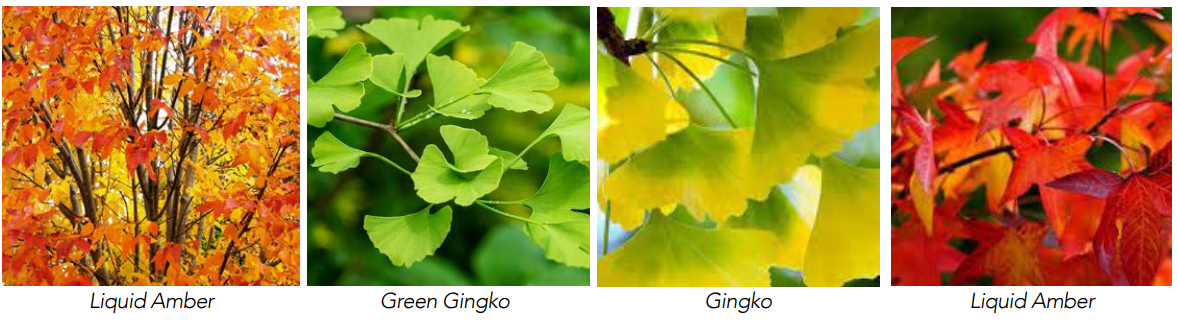
In Oak Park, the leaves on the big sycamores are tawny now. Around town, you’ll see liquid amber trees, with a palette of oranges and maroons, and the ginkgo trees will soon turn a pure brilliant yellow. The lone survivor of an ancient species, these trees shared a landscape with the dinosaurs.

Fall is not just about plants. It’s also about critters—the big Orb Weavers that weave symmetrical webs and then plant themselves in the center waiting for trapped insects. And if you find yourself in the dry country, look for the astonishing sight of tarantulas on the trails in search of mates.

The Trees Above Us

We love our trees at Samarkand. And no wonder. There are about 350 of them on campus, representing 36 different species. Some have seasonal flowers; others are deliciously fragrant even without blooms. One is tall enough to “dust the sky.” Others are broad enough to provide shade on hot days. They give form and shape to the cultivated semi-tropical gardens that grace our 16-acre knoll.

No wonder so many people come here for their final days!

Joyce and Allan Anderson, Magdy Farahat and I worked together to gather information to create labels for many of the trees around the campus. The labels will have both the common and the scientific names of the trees and will be large enough to be easily read. We plan to create a map showing the location of these trees.

The Man Who Loves Fig Trees

Moreton Bay Fig Tree, Santa Barbara

When the Native Plant Garden was installed five years ago, it was decided to leave the old fig tree, although it wasn’t a California native. The tree managed to survive on its lean ration of water. Several months ago new neighbors moved into Eastview, Marty and Magdy Farahat, she a doctorate in music and a flutist and he a retired nuclear engineer. He had been raised in Alexandria, Egypt, a place with a similar climate to ours with a rainy winter and a long, dry summer. Thanks to our long, wet winter, the fig developed a new set of large green leaves. Magdy was inspired to introduce a potted fig to his patio. He also successfully rooted a small branch from the tree. Here was a man who clearly loved fig trees. The fig, an ancient species from Asia spread to the Mediterranean world where for centuries it was revered by the Roman, Greek and Egyptian cultures. In a unique arrangement, the fig fruit itself contains its flowers which are pollinated by a tiny fig wasp that slips into the fruit with pollen on its wings. To add the pleasure of scent to his patio, Magdy found an Arabian jasmine (Jasminum sambac) a local nursery. Its exquisite fragrance pervades the neighborhood of Eastview.

How to Create an Extra Room

The Blooming Mandevilla confirms Saundy’s green thumb!

Balconies aren’t always used for growing plants, they can also be arranged to create illusions. This is what Saundy See has done with her balcony at Magnolia East.

Saundy is a dynamo who arrived at Samarkand earlier this year via Des Moines, Iowa and most recently, from Carpinteria. It doesn’t take long to recognize talent and within two weeks she became the buyer for the Samarkand Treasure & Talent Gift Shop and soon after, the manager, being eminently qualified by her experience owning a card and gift shop in Des Moines. Evidently this new enterprise wasn’t enough to absorb all that energy so she also offers experienced dog and cat care.

Saundy’s Balcony

The photos tell the tale about Saundy’s sleight of hand in her new home.

Notice the balcony chairs turned inward toward the living room while most folks might turn them outward toward the view of the ancient Magnolia tree which, along with the blue urns and the koi pond, date back to the site long before Samarkand became a retirement facility.

Beginning Again — The Native Plant Garden in Early Summer

I had written a nice enough short piece about the native plant garden in early summer to run on my website, and then the piece disappeared from my computer—forever.

I had commented on looking down into the garden and seeing a scattering of California poppies and two white flower spires, the last of the “candelabras” on top of the buckeye tree.  The buckeyes growing on the drier slopes around lowland California are one of the only trees which drop their leaves in late summer rather than in the fall.  The buckeyes are not preparing for winter like most deciduous trees but to avoid the heat of late summer and early fall.  Their large thin leaves can’t take the heat.  But once bare, there is a new beauty to behold – an intricate design of smooth, light gray crooked branches. Donald Culross Peattie in “A Natural History of Western Trees” calls the California Buckeye “an oddly lovely tree.” 

Happy is the hiker who carries a dense smooth buckeye seed in one pocket and a sprig of fragrant California sage in the other.

What I can’t see looking down from my bacony is the bright fuchsia and white splash of color of the clackias (“farewell-to-spring”)– usually the final wildflower display of the spring wildflowers.  This has been a banner year for wildflowers following the winter of generous rains.  Now is the season for the pungent sages and the color purple.  Sturdy bushes of “Alan Pickering” salvia with its powerful aromas must be a clarion call for pollinators.

The garden is shutting down for the season with the quiet business of ripening berries in the sun and roots searching for pockets of moisture.

Seeing the surrounding gardens of bougainvillea, birds-of-paradise and hibiscus, folks complain about the native garden as being “drab.”  I like to sit quietly on a bench and watch the antics of the fence lizards doing their pushups or waiting for the quiet drift of a butterfly which, like the birds, find the garden more interesting than the cultivated ones. Animals come to the garden, too.  A bobcat passes through and once a mountain lion made a brief appearance.

I like the idea of matching our natures to the natural rhythms of nature itself.  
And I can’t resist commenting on the unusual weather (is there such a thing as “usual” weather?)  It appears that the long, cool wet winter has slid almost seamlessly into a cool moist early summer with an abundance of clouds.  In the Sierra, the days remain in the low 60s with regular afternoon showers and in the Central Valley the temperature rarely rises above 80 degrees, a welcome relief from the normal summer heat.  Here on the coast, it is best described as gloomy and grayer than usual. This pattern is likely to change soon.
Two Red Rocking Chairs

Sylvia’s Patio by Sue Fridley

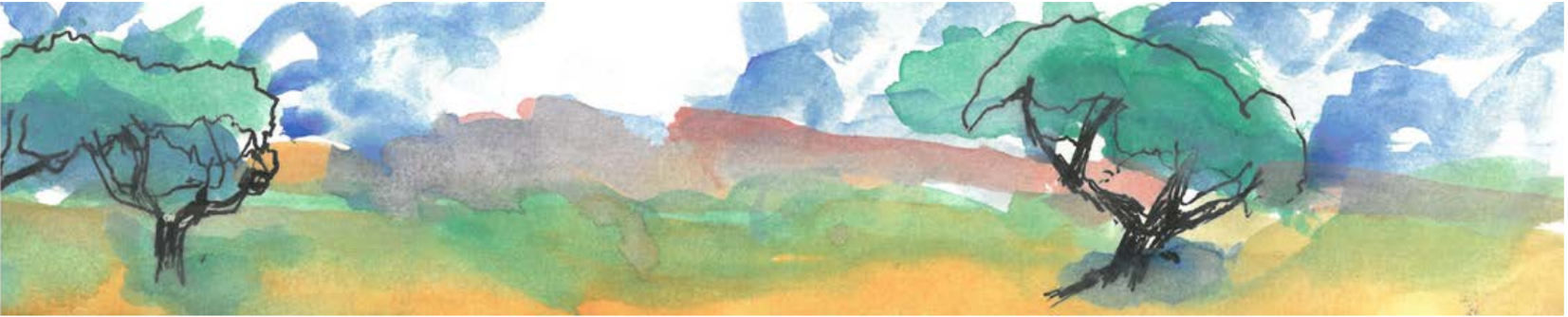
As you approach the entrance to buildings Northview and Westview, your eyes may be drawn to two red rocking chairs on a small patio in back of Sylvia Casberg’s apartment. The patio is surround by a simple wrought iron fence and a gate that is always open. Potted red geraniums hang from the eave and two beautiful wind chimes make music in the lightest breeze. A curving pathway of crunchy white gravel leads to the street. A white pottery birdbath attracts birds and the attention of photographer Tom Ginn. In early summer the garden features a bird of paradise plant surrounded by California Poppies and orange nasturtiums. Later, saucer-sized red- orange hibiscus attracted watercolorist Sue Fridley, whose painting is featured here.

Asking about Sylvia’s early garden experience, she said, “As a child I was encouraged to grow a Victory Garden but only radishes came up which I figured weren’t going to win a war. I had better luck when nurseries began offering small plants. I talked to the plants reminding them that ‘you grow or out you go.’”

Male Western Bluebird on Sylvia’s Birdbath (Photo by Tom Ginn)

If you walk by early in the morning, you may see Sylvia wrapped in a blanket enjoying a cup of coffee. Later in the day it might be a glass of wine sipped as she enjoys the sunset.

More About Interspecies Feeding Among Birds

Pacific Coast Flycatcher

Dear Friends:

In order to do justice to Ann Allen’s lovely painting of her birdbaths in Where The Birds Are, I eliminated two photos which helped tell the story.

Interspecies bird feeding is unusual but not rare. The behavior is fueled by the powerful hormones which respond to the lengthening days in the spring.

Birds (male or female) may become a “helper” if their own nest is destroyed or if a bird is unable to find a mate. If nestlings have lost their parents and their calls are loud and persistent enough, a neighboring bird of another species may fill in as a parent.

Nestlings and fledglings learn their songs and calls from the feeding parents. Results can sometimes be disastrous as in the case where the helper, a gull of one species feeds gull of another species and the recipients no longer know when to migrate, I’m assuming our four juncos grew up to be proper adult juncos and didn’t leave for Mexico in the fall.